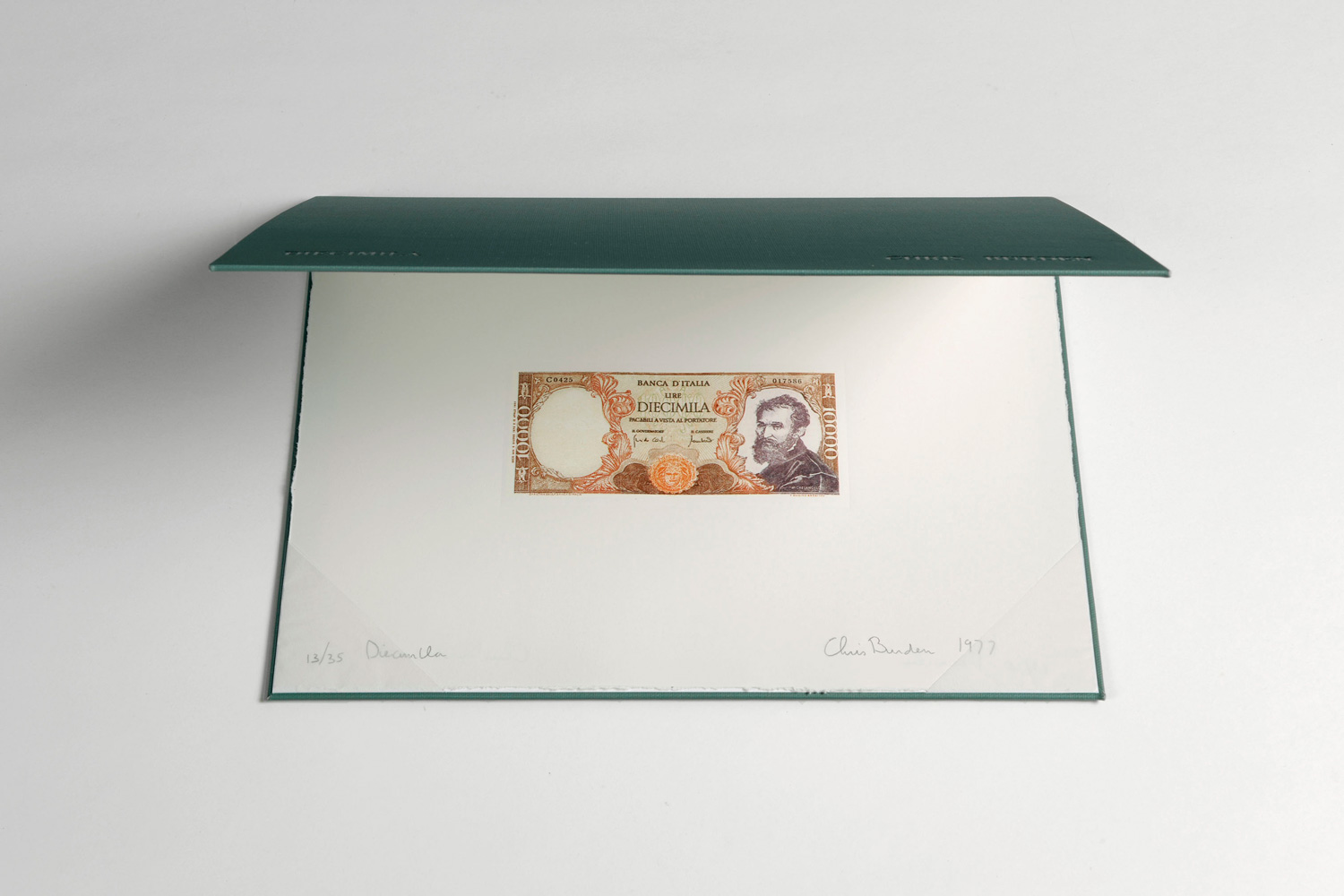
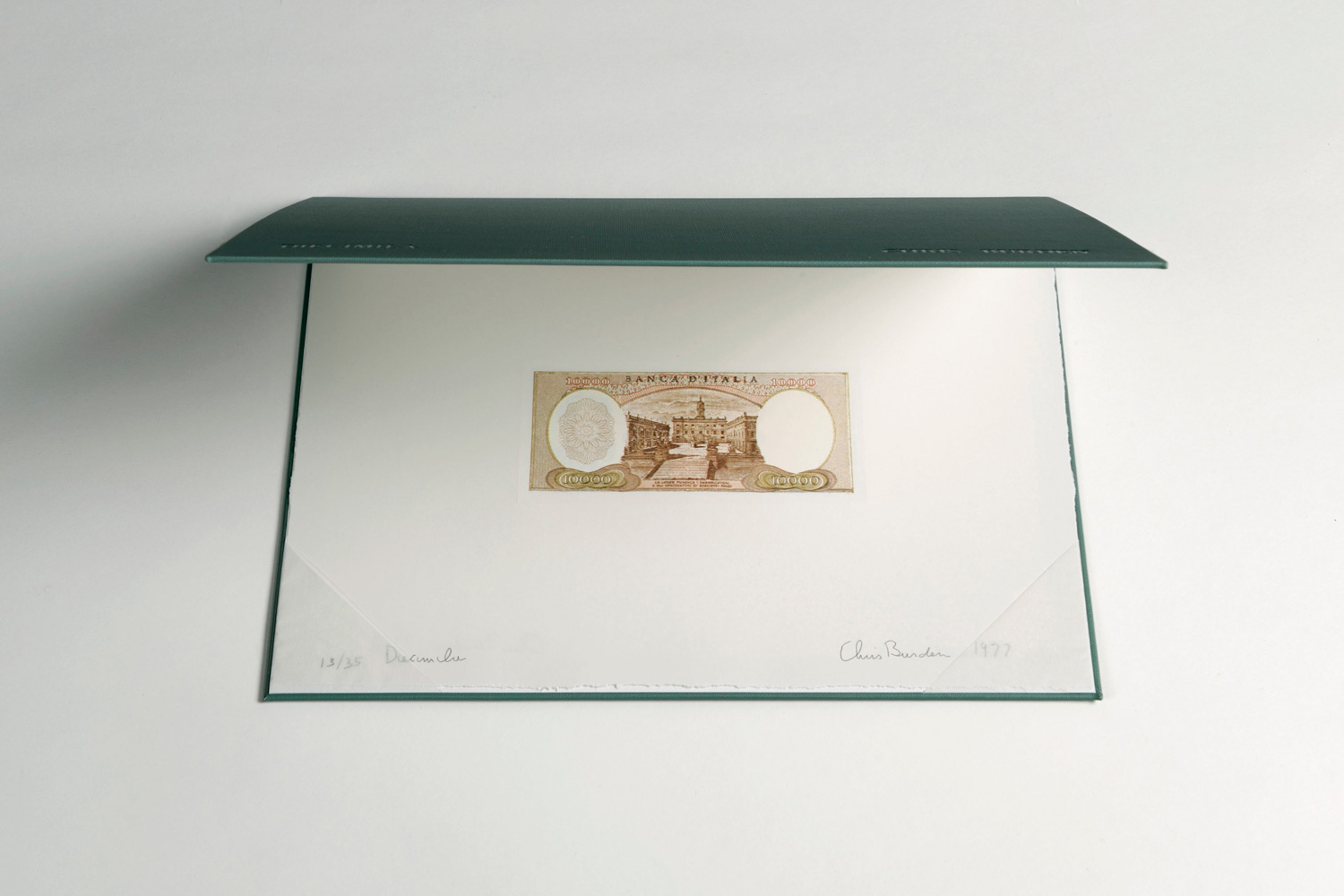
Jonathan Monk Diecimila, 2010
Specifications
Portfolio, 27.2 x 36.4 cm
Contains one sheet, 26 x 35.6 cm
Photo-engraving by Patrick Laurensis and Luc Lorent
Printed recto-verso on Bioset paper 115g by Arte-Print
Silkscreen of the portfolio by SP Production and bound by Rozier
Production
Edition of 35 numbered and signed copies and 5 artist's proofs
Certificate signed and numbered by the artist
Produced and published by mfc-michèle didier in 2010
©Jonathan Monk and mfc-michèle didier
NB: All rights reserved. No part of this edition may be reproduced in any form or by any means without written permission of the artist and the publisher.
Jonathan Monk often bases his work on the reinterpretation of pre-existing works, demonstrating a particular affinity for the sixties and seventies. Monk has raised the citation to the level of art to such an extent that one could liken his art to a history of art.
With Diecimila, the artist adopts a more radical stance by purely and simply appropriating Chris Burden's eponymous work of 1977. The work Diecimila consists of a double-sided facsimile of an Italian 10,000 lire banknote. It is, in a way, a fake banknote (and a real work of art), signed by the artist Chris Burden.
Monk replaces Burden here, and goes so far as to imperil the notion of the ownership of the work, duplicating also his predecessor's signature. The edition of 35 copies is similarly repeated. Even the multiplication is reproduced: pure tautology.
A banknote as an art object leads naturally, and literally, to the question of the value of art, a fluctuating notion if ever there was one. No longer in circulation, the Italian 10,000 lire note to which Burden referred in 1977 has since lost its exchange value to acquire that of a collector's item.
From publisher to forger, and back again.
In 2009, Jonathan Monk approached me with the proposal to (re)publish Chris Burden's Diecimila. His offer was quickly followed by a sinister warning: “I've spoken to other editors about this project, but they all turned it down due to the risk involved.” I wasn't fooled by what seemed like a strategy, but my taste for challenges and my interest in both Monk's and Burden's work were enough for me to take him on.
To this day, criminal law punishes the counterfeiting of banknotes with a prison sentence. With Monk's Diecimila we are dealing with a double forgery: firstly the copy of Burden's work and secondly – implicitly – the imitation of a 10,000 lira note originally carried out by Burden in 1977.
Re-appropriation is an important historical phenomena because it is essentially an aim, a plan, an intention to write or rewrite history. It is a blessing for those whose memory is failing, and a stimulus for critics who must not rest on their laurels. And, artists who practice re-appropriation are rewarded: their work is relevant and they represent a contemporary belief that it is possible to have a “grasp” on all things.
Besides, the art market often gives more value to the re-appropriating artwork than to the original one (take Claude Closky's Pick and Hammer for example).
I remember Robert Barry telling me his favorite artist was Jonathan Monk because he gave his work a revival. You can call it re-appropriation or you can call it recognizing the value of history again.
However, there are of course some pitfalls to watch out for, and in the case of Burden's Diecimila we can ask ourselves: is the transgressive nature of the 1977 work still intact when it is “imitated”? Because the re-appropriated work becomes something else, even if it is completely identical. It allows us to either ignore or take a different approach to the issue of “true or false” and the question of copies (I'm thinking of Goupil here).
Monk approached me as a publisher, and asked me to take on the role of forger. And I did it, with great pleasure. I've also had the opportunity to practice the craft of counterfeiting with other publications like Allen Ruppersberg's The New Five Foot Shelf of Books or Annette Messager's Mes dessins secrets.
With Diecimila, the artist adopts a more radical stance by purely and simply appropriating Chris Burden's eponymous work of 1977. The work Diecimila consists of a double-sided facsimile of an Italian 10,000 lira banknote. It is, in a way, a fake banknote (and a real work of art), signed by the artist Chris Burden.
Monk replaces Burden here, and goes so far as to imperil the notion of the ownership of the work, duplicating also his predecessor's signature. The edition of 35 copies is similarly repeated. Even the multiplication is reproduced: pure tautology.
We can observe that the mimetic operation carried out by Jonathan Monk is split in two, for the work to which Monk refers is itself a facsimile of a pre-existing object. Jonathan Monk's identical reproduction of another artist's work is a conceptual act, with the added irony that the copied work is itself a work of conceptual art.
A banknote as an art object leads naturally, and literally, to the question of the value of art, a fluctuating notion if ever there was one. No longer in circulation, the Italian 10,000 lira note to which Burden referred in 1977 has since lost its exchange value to acquire that of a collector's item.
Furthermore, the choice of this banknote was not accidental, for engraved on it is the three-quarter portrait of Michelangelo. The aura of the artist competes with that of money. But in this case the battle was long won.
As for Monk, he asserts and consolidates here his position as an artist of succession and legacy. He develops his work according to the principle of kinship, which, no sooner dreamed of, comes true.
Born in 1969, the artist never ceases to look back over the years of his birth. And it is not without insolence that the artist converts the art of those decades – an art of rupture – to inscribe it in a new genealogy of which, ultimately, he is the sole founding father…
Text written by Michèle Didier and read on January 29, 2018 in Vienna at:
Kunsthalle Wien GmbH, Hektor Peljak Museumsplatz 1,1070 Vienna, on the occasion of the exhibition Publishing as an Artistic Toolbox: 1989–2017.